
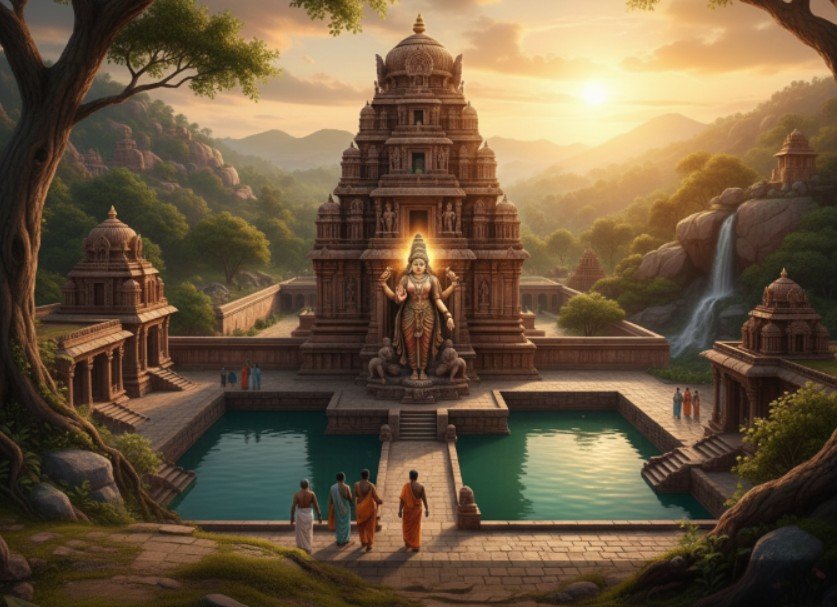
Faith plays a very important role in Indian culture, and to truly understand it, one must learn about Shakti, the sacred feminine power of the universe. Shakti Peeth in Andhra Pradesh holds deep spiritual significance, as the state is one of the most important regions for the worship of the Goddess. Even today, people across Andhra Pradesh continue to follow ancient stories, sacred traditions, and religious practices that have been passed down for generations. These holy places are believed to possess immense spiritual and mental power, attracting devotees seeking strength, protection, and inner peace.
A lot of history can be found in some of the most important places in Andhra Pradesh. India began to honor Shakti because she gave them such a holy gift. People from Andhra Pradesh started going to these holy places more often over time. They were liked by people who wanted to believe, be at peace, and get help from God.
A look at how and why Shaktipeeth came to be
You need to know where Shakti Peeth in Andhra Pradesh came from to truly understand how sacred and important these holy sites are. According to Hindu mythology, Lady Sati was the first wife of Lord Shiva and a powerful embodiment of divine feminine energy. Ancient texts describe how King Daksha, Sati’s father, insulted Lord Shiva during a grand yajna. Unable to bear the humiliation of her husband, Sati immolated herself in the sacrificial fire.
They made holy every place a body part fell. A lot of people believe that these places are very holy and that different forms of the Goddess live there. “Shakti Peeth,” or “Sati body parts,” are important to Shakti Peetha’s history. Because of this thought, many people in Andhra Pradesh still give Devi a lot of praise.
There are shrines to Shakti Peeth in Andhra Pradesh
Andhra Pradesh has revered Shakti Peeth in Andhra Pradesh since ancient times, with roots deeply embedded in the Vedas as well as in everyday life and local traditions. For generations, people across the region have worshipped the Goddess as the supreme protector, creator, and destroyer of evil forces. This devotion to the Divine Mother is not limited to scriptures alone but is vividly reflected in festivals, rituals, and social customs that continue to shape religious life in the state.
The worship of Shakti Peeth in Andhra Pradesh takes many forms, blending classical Hindu practices with strong regional beliefs. Over time, religion, culture, and society have influenced how the Devi is perceived and honored. As a result, different communities have developed unique ways of expressing their faith, which can be clearly seen in the diverse rituals and traditions followed in Devi temples across the state.
There are various forms of Goddess worship associated with Shakti Peeth in Andhra Pradesh. Devotees pray to Durga, Kali, Lakshmi, and several local manifestations of Shakti, each representing a different aspect of divine feminine power. These temples are often architecturally and spiritually unique, giving them deep emotional and devotional significance. Because of this, they are regarded as powerful sacred spaces where devotees connect with Maa Shakti and seek strength, protection, and blessings.
In Andhra Pradesh, how many Shaktipeeth are there?
A lot of religious people want to know how many shaktipeeth the Andhra Pradesh government recognizes. Thoughts and books from the past that talk about Shakta say that one of the ancient Shaktipeeth is in Andhra Pradesh. There are a lot of old, spiritually powerful churches in the area. People also think of them as holy Shaktipeeths. This is why the practice at the Andhra Pradesh Shakti Peeth is important and changes over time in terms of religion.
Puruhutika Devi is the most important person for women in Andhra Pradesh to pay attention to.
It is the most important and well-known shaktipeeth in Andhra Pradesh. The spot is in Pithapuram, which is in the East Godavari district. Sharīti believers think that this is where Goddess Sati’s left hand fell. They care a lot about this building because of this. As well as Kukkuteswara, people honor Lord Shiva and the Goddess. This proves that Shiv and Shakti will always be together.
A lot of information has been written about the temple of Puruhutika Devi. It’s known as Astha Dasha Shakti Peetha. People who pray here believe that it gives them thoughts, frees their spirits, and gets rid of bad luck. The Devi Shaktipeeth tradition in Andhra Pradesh is based around this holy site.
Andhra Pradesh is home to many of the most famous Devi sites for people who follow the Shaktipeeths. In Andhra Pradesh, people still come from all over the country to see these Shaktipeeth because they have important stories linked to them.
One of the best known places to pray to Devi in Andhra Pradesh is the Kanaka Durga Temple in Vijayawada. This temple is built on a hill next to the Krishna River. Goddess Durga kills Mahishasura when she is in her strong form. They believe that the Goddess keeps bad things out of this area. In Andhra Pradesh, this temple is often seen as a holy place.
The Mangalagiri Panakala Lakshmi Temple is another important spot to pray to Shakti. A lot of people have been going to this temple for a long time. It is famous for the ceremony where sugar water is given to the Goddess. A lot of people in Andhra Pradesh think it is an old Shaktipeeth because it has a strong spiritual life and has been around for a long time.
Near Kurnool is the Yaganti Uma Maheswari Temple, where you can respect both Shiva and Shakti without any problems. It’s in a strange place because it was built in an old cave. It was a way for people to honor Devi. In Andhra Pradesh, it is a very important Hindu temple.
A Quick Look at the History of the Shaktipeeth in Andhra Pradesh, South India
Andhra Pradesh, a culturally rich state in South India, has long preserved the worship of Shakti Peeth in Andhra Pradesh, making it a vital part of its spiritual heritage. The traditions here are unique because they blend influences from various regions. While some forms of devotional music and practices have roots in Tamil Nadu, the local people of Andhra Pradesh have adapted them to honor the Goddess in their own distinctive way.
The shaktipeeth temples in Andhra Pradesh are important to religious people and people who study Hinduism because they bring together different practices in a way that makes sense.
How Shaktipeeth got to be in Andhra Pradesh
In Andhra Pradesh, they have been around for a very long time. You can see this in old books, songs, and churches. People from the Satavahana era, the Eastern Chalukya era, and the Vijayanagara era worked hard to build and protect places for Devi. In the past, many churches have been fixed up, but they have always had a place where people can go to pray.
People still pray at these churches, which shows that the Shakti faith has been strong in Andhra Pradesh for a long time. For people who love Devi, this is why the place is one of the most important in India.
Why it’s important to know the Hindu story of Shakti Peetha
People believe that Shekhar, who represents pure mind, and Shakti, who runs the world, are the same thing. People in Andhra Pradesh believe that the Goddess is the most powerful being, which makes this thought very strong there. Shakti is what makes things possible. Every day, people in Andhra Pradesh respect and enjoy this fact.
A lot of Hindus in Andhra Pradesh go on trips called pilgrimages.
These are some of the most important places in Andhra Pradesh for Hindus to visit. Ahobilam, Srisailam Mallikarjuna Jyotirlinga, and Tirupati Balaji are all places that help people on their spiritual road. For religious people, these places are very important. Of course, they also make Andhra Pradesh one of the best Indian states.
In this way, the shaktipeeth in Andhra Pradesh keep the area’s spiritual past alive and the power of the holy woman alive. People from all over the state of Andhra Pradesh come to worship Shakti at the holy Puruhutika Devi Shaktipeeth and other well-known Devi shrines. Faith in Shakti is still strong in the state. A lot of people still respect these holy places. They also help spiritual seekers find their own power and God’s kindness.
At the Andhra Pradesh Shakti Peeth, you can learn a lot about Shakti, Hindu lore, and the holy trip.
FAQ
What is the importance of Shakti Peeth in Andhra Pradesh?
Shakti Peeth in Andhra Pradesh represents the divine feminine power that has been worshipped in the region since ancient times. The state is known for its deep-rooted Devi traditions, sacred Shaktipeeths, and powerful Goddess temples. Devotees believe that Shakti here protects society, removes negativity, and grants spiritual strength, making Andhra Pradesh one of the most important centers of Goddess worship in India.
How many Shaktipeeths are there in Andhra Pradesh?
According to classical Hindu scriptures, there is one main Shaktipeeth in Andhra Pradesh, which is the Puruhutika Devi Shaktipeeth at Pithapuram. Along with this, several ancient and spiritually powerful Devi temples are locally revered as Shaktipeeths due to their strong religious history and continuous worship.
Which is the most famous Shaktipeeth in Andhra Pradesh?
The most famous and widely accepted Shaktipeeth in Andhra Pradesh is the Puruhutika Devi Temple in Pithapuram. It is believed that Goddess Sati’s left hand fell at this place, making it one of the Ashta Dasha Shakti Peethas and a highly sacred site for devotees of Maa Shakti.
Why is Andhra Pradesh important for Shakti worship in South India?
Andhra Pradesh holds a special place in South India because it connects ancient Shakti traditions with Bhakti and Tantric practices. Shakti Peeth in Andhra Pradesh reflects a blend of Vedic rituals, local beliefs, and devotional movements, which makes the region spiritually unique and deeply respected among Shakta followers.

Krishna Mishra writes for Insights of Hinduism, where he shares heartfelt thoughts on festivals, traditions, and the timeless wisdom of Sanatan Dharma. His aim is to keep the essence of Hindu culture alive in a way that feels simple, authentic, and relatable to everyone.